1,000,000,000 XRP Unlocks Every Month. Here's What Actually Moves.
Every first of the month, the same ritual: up to one billion XRP is released from escrow, and headlines frame it as a flood about to hit the market. This weekend it happens again. So instead of predicting what it means, let's do something more useful — measure what it looked like the last few times, on the ledger itself.
What the escrow actually is
In 2017, Ripple placed 55 billion XRP into ledger-enforced escrow contracts — locked not by promise but by the XRP Ledger's own rules. Each month, a scheduled batch (up to 1 billion) becomes available. Whatever isn't used is typically returned into new escrow contracts at the back of the queue. All of it — the release, the usage, the re-lock — is visible on-chain within days, verifiable by anyone. No press release required.
What the release looks like in ledger data
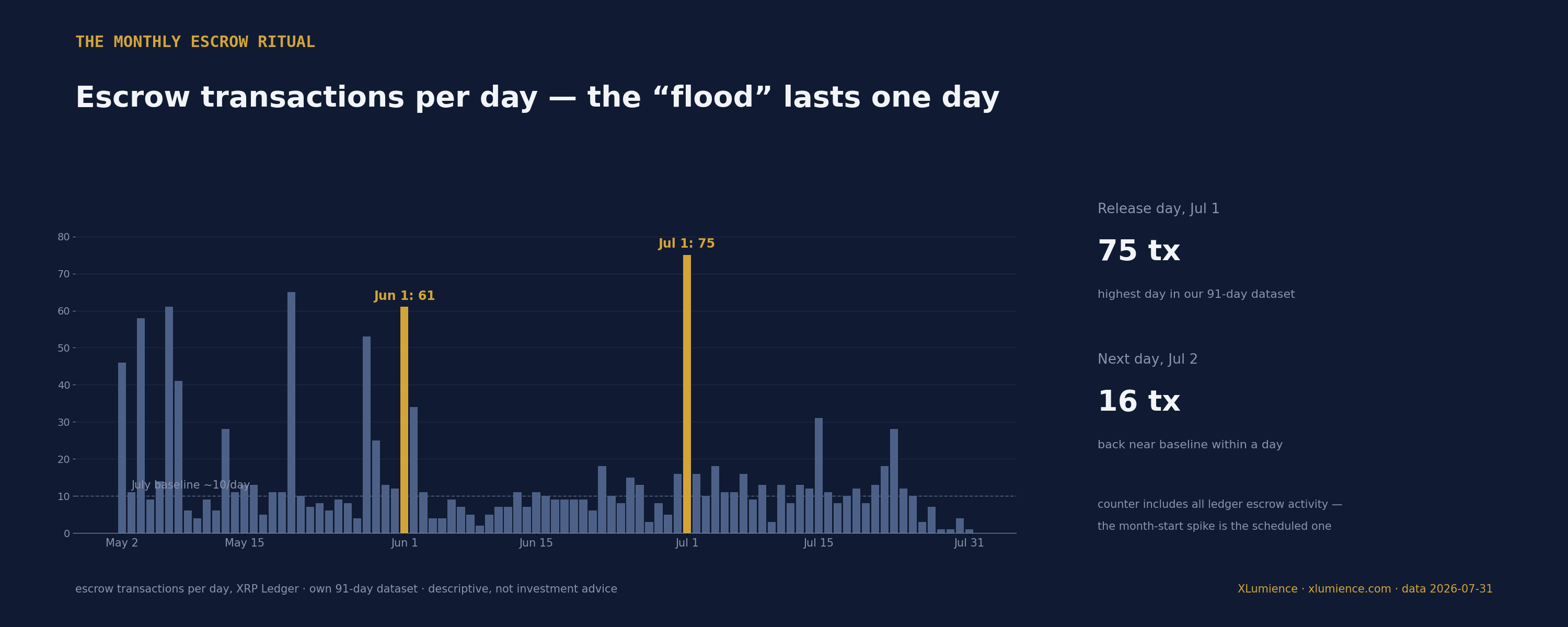
We keep a rolling 91-day dataset of XRP Ledger activity. One of the columns counts escrow-related transactions per day. Here's the pattern.
Through most of July, the ledger processed roughly 8 to 15 escrow transactions a day — routine background noise. On July 1, that number jumped to 75, the highest single day in our entire dataset. On June 1: 61. By the second day of each month, the count was back near baseline.
One honest note on the counter: it picks up all escrow activity on the ledger — companies and individuals use escrows too, so occasional spikes show up mid-month. The one you can set a clock by is the first of the month.
That's the "flood": a one-day administrative spike, gone by breakfast the next morning. The mechanics are calendar plumbing, not a market event.
The number that would actually matter
An unlock only touches the market if the XRP ends up somewhere it can be sold — which shows up as sustained inflow to exchanges, not as an escrow transaction count. That's measurable too, against a baseline of what's normal.
Right now our exchange-flow tracker reads quiet: the 14-day netflow z-score sits at −0.29 — slightly outflow-dominant, well inside the normal band. For scale: the largest single-day net moves in July were around ±12 million XRP. Set that against the one-billion headline number and you see why the ledger barely reacts to release day — the market simply never meets most of that billion.
How to read this weekend, then
Not: "1B unlocked, brace for impact." But: watch whether exchange netflow leaves its baseline band in the days after the release, and whether it stays out. One elevated day is noise. A sustained shift is information. Historically, the majority of each release has been returned to new escrows — and the exact split is on the ledger within days, where anyone can check it.
That's the general habit this monthly ritual rewards: ignore the scheduled number everyone already knows, and measure the unscheduled behaviour around it.
One billion XRP will make headlines this weekend. The ledger will most likely shrug. If it doesn't — if the flow data actually leaves its band — wouldn't that be the story worth reading about next week?
XLumience publishes daily XRP intelligence — on-chain, regulatory and market context, logged transparently, misses included. This is descriptive analysis, not investment advice.