Japan's FSA Made Two Crypto Moves in One Week. Most Coverage Caught Only One.
In the first week of August, Japan's Financial Services Agency did two things that will shape how crypto works in the country for years. On August 5 it announced an internal reorganisation that upgrades crypto's place in its own organisation chart, effective August 7. On August 6, jointly with the National Police Agency, it asked the exchange industry to tighten how customers withdraw crypto.
Crypto media mostly covered the first. General press mostly covered the second. Read together, they describe the same thing: what "crypto as a financial product" is actually going to look like in Japan.
The upgrade: from side office to line division
Until last week, crypto oversight at the FSA lived in a counselor's office — a sanjikan-shitsu (参事官室), a construction Japanese ministries typically use for emerging or cross-cutting topics. As of August 7, it is a full division — a ka (課), reported across Japanese media as the Crypto Assets and Stablecoins Division.
That sounds like bureaucratic trivia. It isn't. A division sits in the standing organisation chart; a counselor's office is a lighter, more provisional arrangement. Ministries reorganise around what they expect to supervise permanently. The FSA just told you, in its own administrative language, that crypto supervision is no longer a temporary assignment.
The reason is on the calendar. On July 15, Japan's parliament passed the FIEA amendment — the law that moves crypto-assets from the Payment Services Act into the Financial Instruments and Exchange Act, the same framework that governs securities. Insider-trading rules, disclosure duties, re-registration of every exchange. Roughly 105 assets, XRP among them, were slated for the new regime when the list was drawn up. Nearly all of the work that law creates — the implementing orders, the disclosure templates, the ETF approval framework — lands on FSA rulemaking. The agency just built the unit that will carry it.
The clock that runs through everything
The sequence, as it stands today:
July 15, 2026 — FIEA amendment passed. July 29 — the cabinet order for the first tranche of provisions was promulgated; implementation has left the station. August 5–7 — the reorganisation, announced and in force. Second half of 2026 — draft implementing orders and public consultations; this is where disclosure rules, capital requirements and the ETF approval framework get written. Around mid-2027 — full entry into force expected (the law allows up to one year after promulgation), followed by a six-month re-registration window for exchanges. Around 2027 — the realistic window for the first spot crypto ETF decisions and Tokyo Stock Exchange listings, per exchange-side planning. January 1, 2028 — the intended start of the flat 20% tax on crypto gains.
One correction worth repeating, because most coverage still gets it wrong: the 20% tax is not part of the FIEA amendment. It sits in separate tax legislation on its own timeline. Two laws, two clocks. Conflating them produces most of the bad "Japan crypto tax 2026" headlines you've seen.
And one asset-specific marker, stated precisely: SBI publicly presented a spot Bitcoin + XRP ETF plan in May 2026, aimed at a TSE listing. No formal filing is confirmed — none can be, until the regime is in force. That is the honest state of the "Japan XRP ETF" story today: prepared, not filed.
What the ledger did during all this
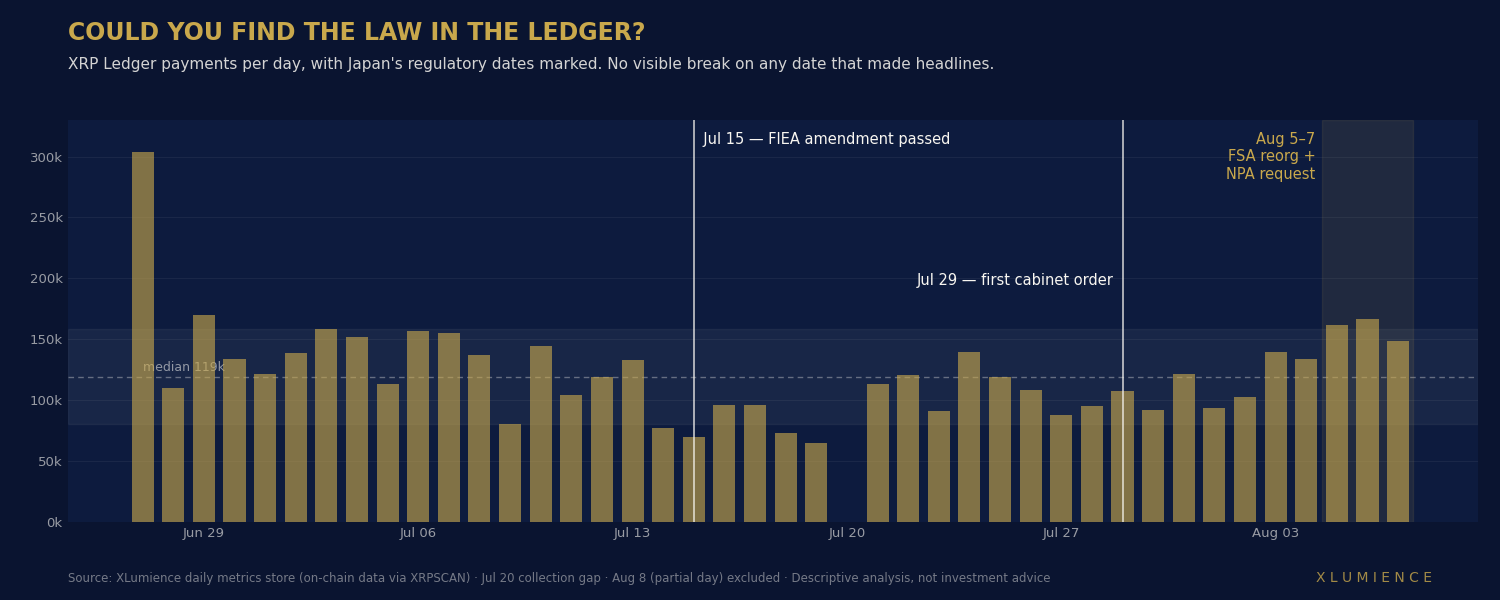
One habit from our own kitchen: when the news is this loud, measure whether anything actually moved. We keep a daily on-chain metrics store (sourced from XRPSCAN). The chart at the top of this page shows XRP Ledger payments per day since late June, with the regulatory dates marked. July 15 — the day the amendment passed — was one of the quietest payment days in the entire series: about 70,000 against a median of roughly 119,000. July 29: unremarkable. The reorganisation week sits toward the upper end of the range — at levels an ordinary week in early July also reached. One honest footnote: total transaction counts (all types, not just payments) did run hot this week; we can't attribute that to anything specific, so we won't.
Laws change what's legal. They don't move payment flows on the day. If Japan's new regime ever shows up in this chart, it will be slow — new corridors, new listings, new products — not a headline-day spike. Worth remembering for every date on the timeline above, including the ones still ahead.
The other move the same week: tighter rails
On August 6, one day after announcing the reorganisation, the FSA issued a request to the Japan Virtual and Crypto Assets Exchange Association — jointly signed with the National Police Agency. The word matters: a request (yōsei) to the industry's self-regulatory body, not a regulation. But the list is concrete, eleven measures long, and three of them are structural:
Withdrawal restrictions for a set period after fiat deposits or crypto purchases. Pre-registration of withdrawal destinations, with a restriction period after any new address is registered. Withdrawal limits, set appropriately.
The rest covers stricter identity checks at account opening, transaction and access monitoring, faster freezes on suspicious activity, and closer information-sharing with police. The stated background: fraud schemes growing more sophisticated, and proceeds of "special fraud" — Japan's term for phone and impersonation scams — flowing into exchange accounts. This is not an isolated move either: in late May, the FSA and the police agency launched a joint framework for tracing and freezing fraud funds across financial institutions. And the FSA's own wording — a renewed request — tells you the agency did not consider the previous round sufficient.
The industry's first answer arrived within 48 hours. On August 8, bitFlyer CEO Yuzo Kano responded publicly: uniform restrictions on long-standing customers are unnecessary, he argued, because most fraud follows one pattern — a newly opened account, followed by an immediate withdrawal. His counter-proposal: concentrate the measures on new accounts and high-risk transactions, and leave existing customers' convenience intact. It is exactly the degree of freedom the format of the request allows. Because the FSA asked rather than ordered, the design of the restrictions now sits with individual exchanges — which means the practical answer to "how easy is it to withdraw crypto in Japan" will be written not in the request's eleven measures, but in each exchange's implementation of them. That is the thing to watch over the coming weeks.
How Japan is reading it
Within the Japanese crypto community, one widely shared reading of the week: each new layer — registration, disclosure, and now tighter withdrawal controls — weighs heavier on small platforms than on large ones, and the sum favours the biggest, most compliance-capable exchanges. Consolidation, in other words. We can't measure that from here, and we're not endorsing it; we note it because it is the local frame, and because compliance overhead of this kind does, as a rule, cost less per customer at scale.
One regulator, one week, two tracks
Here is the point of reading the two moves together. Market access and consumer protection are usually covered as separate stories, for separate audiences. In Japan this week they were the same regulator, the same seven days. Financial-product status cuts both ways: it is what makes spot ETFs legally possible, and it is also what brings bank-grade friction to the retail edge — registered withdrawal addresses, cooling-off periods, withdrawal limits.
By the time the first ETF decisions land, somewhere around 2027, pre-registered withdrawal addresses may already be everyday reality on Japanese exchanges. One of these two tracks will get the headlines. Which one will have changed daily crypto life in Japan more?
Tell us — two doors
If you have a quick take, pushback or a one-line correction: reply under the article post on @XLumience. If you have something longer — a counter-reading, a data request, a correction with sources: come through our contact page. We read everything, and corrections get logged openly. Misses included; that's the house rule.
Sources: FSA press releases of 5 August (organisational restructuring) and 6 August 2026 (joint request with the National Police Agency), fsa.go.jp; FSA publications index; FIEA amendment timeline per FSA materials and legal analysis (So & Sato). Where a detail is media-reported rather than confirmed in a primary source — the division's English name, the ~105-asset list — we say so.
XLumience publishes daily XRP intelligence — on-chain, regulatory and market context, logged transparently, misses included. This is descriptive analysis, not investment advice.