XRP's September: six events, one vote, and a decision about who holds the pen
In February, the Polymarket contract "Clarity Act signed into law in 2026" traded at 82 percent. This week the same contract sits far below it, and almost none of that collapse is about crypto. It is about an ethics provision covering the president's own digital asset income, and about which seven Democratic senators will cross the aisle without one they consider enforceable.
The White House has now put a date on the end of the argument. Patrick Witt, executive director of the Presidential Council of Advisors for Digital Assets, said of the Senate: "If they can't get there by September 15, they never will." What that does not do is decide whether the United States gets a crypto market structure. That is already happening somewhere else.
The part almost nobody is pricing
While the Senate has been stuck, the regulators have started writing. The SEC proposed a rule called Regulation Crypto Assets on 18 August, days after the Senate left for recess without voting, building on the SEC and CFTC memorandum of March and its five part token taxonomy. Japan is further along: the FIEA amendment passed on 15 July, the cabinet order for the first tranche was promulgated on 29 July, and full entry into force is expected around mid-2027.
Which changes what 15 September decides. The question on the floor is not whether this market gets rules. It is whether the American rules are written by Congress, with the durability that implies, or by two agencies working inside the authority they already have.
What our own August data shows
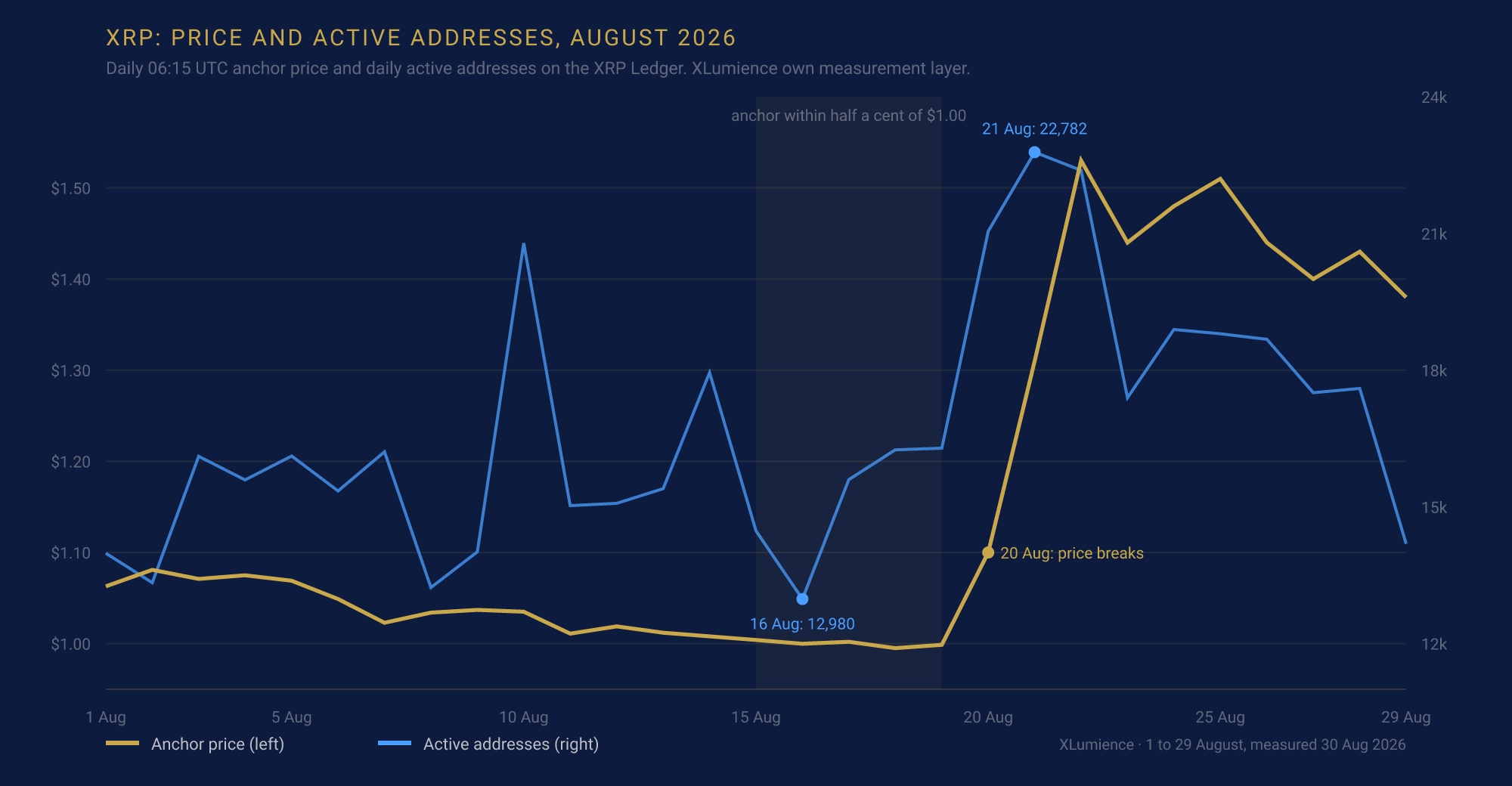
Participation arrived after the move, not before. Active addresses bottomed at 12,980 on 16 August and peaked at 22,782 on 21 August, the day after the price broke. The busiest transaction day of the month came four days after the price high. Across the 742 exchange wallets we track, six of the seven days from 22 to 28 August were net inflows to exchanges while the price moved sideways.
What the full article covers
The six scheduled events between 8 and 18 September and why five of them are macro or Japan. What a cloture vote on the motion to proceed actually is, and the sequence that follows if it succeeds. Three outcomes rather than two, and what each hands to whom. The misinformation our own daily sweep of the X conversation surfaced on 28 August, and why the gap between what happens and what gets understood may matter more that week than the vote itself. What regulation looks like from the retail edge rather than the institutional one. And how much room the price is likely to need, measured on our own published ranges: 89.3 percent coverage across 112 resolved daily reads, with coverage flat across band widths.
Tell us — two doors
If you have a quick take, pushback or a one-line correction: reply under the article post on @XLumience. If you have something longer — a counter-reading, a data request, a correction with sources: come through our contact page. We read everything, and corrections get logged openly. Misses included; that's the house rule.
Sources: Polymarket contract "Clarity Act signed into law in 2026"; Patrick Witt, Presidential Council of Advisors for Digital Assets, as reported August 2026; SEC press release 2026-76 and proposing release 33-11434; Senate floor schedule and reporting on the cloture filing of 8 August 2026; ECB, Federal Reserve, Bank of Japan and BLS published calendars; Japan's FIEA amendment of 15 July 2026 and the cabinet order of 29 July, verified against our own FSA reporting of 10 August; own measurement layer, figures dated 30 August 2026.
XLumience publishes daily XRP intelligence — on-chain, regulatory and market context, logged transparently, misses included. This is descriptive analysis, not investment advice.